
Energy
Is solar worth it in 2026? PV systems, payback, balcony solar
Is solar worth it in 2026? The short answer
Yes, in the vast majority of cases. The question has changed shape over the last few years: it is no longer whether photovoltaics pay off at all, but when it pays off most.
The price drop made it possible. Module prices have fallen by almost a third since the boom of 2022/2023, because new suppliers entered the market and demand in the supply chain normalised (as of 2026). On top of that, 0 percent VAT on purchase and installation applies since 2023 (as of 2026). At the same time grid power stayed expensive, around 35 to 37 euro cents per kWh for households. That gap between a cheap system and expensive grid power is the basis of every calculation.
The market trend matches. At the end of 2025 Germany had around 4.8 million photovoltaic systems installed, up 17.6 percent within a year (March 2026). Together with balcony solar panels, more than 5.7 million solar systems delivered around 117 gigawatts by the end of 2025 (Jan. 2026). Solar covered 16.8 percent of German electricity generation in 2025 and has moved up to become the second most important energy source behind wind (Jan. 2026).
The key figures for 2026 in one table:
| Figure | Value 2026 |
|---|---|
| Turnkey cost | about 1,100 to 1,700 euros per kWp (0 % VAT) |
| Specific annual yield | average 965 kWh per kWp, up to 1,120 in the south |
| Self-consumption rate | 25 to 35 % without, 60 to 70 % with storage |
| Payback time | 7 to 10 years, faster with self-consumption |
| Return | 4 to 8 % per year |
| Rooftop systems in Germany | 4.8 million (end of 2025) |
| PV share of the power mix | 16.8 % (2025) |
What a PV system costs in 2026
The price per kilowatt peak, the rated capacity, is the most important comparison figure. A complete system, turnkey with installation and inverter, costs about 1,100 to 1,700 euros per kWp in 2026 depending on region and supplier, at 0 percent VAT (as of 2026). Other estimates put the range at 1,000 to 1,800 euros depending on whether storage is included (as of 2026).
A concrete example table for typical system sizes without storage:
| System size | Annual output | Roof space (approx.) | Cost incl. installation (from) |
|---|---|---|---|
| 5 kWp | around 4,800 kWh | 20 m² | from 9,600 € |
| 7 kWp | around 6,600 kWh | 30 m² | from 10,900 € |
| 9 kWp | around 8,500 kWh | 40 m² | from 12,200 € |
| 12 kWp | around 11,000 kWh | 50 m² | from 14,800 € |
(as of 2026)
Larger systems are cheaper per kWp because the fixed costs for the inverter, scaffolding and connection spread over more capacity. Around 10 to 20 percent of the total cost is the installation itself (as of 2026).
Running costs come on top. Annual maintenance sits at about 1 to 2 percent of the purchase price, and the inverter usually needs replacing after 10 to 15 years at around 1,000 to 2,500 euros depending on size (as of 2026). The modules themselves typically last 25 to 30 years at an annual degradation of only 0.3 to 0.5 percent (as of 2026). How these follow-up costs add up over 20 years is worked out cleanly in the Solar maintenance cost calculator.
How much power a system delivers
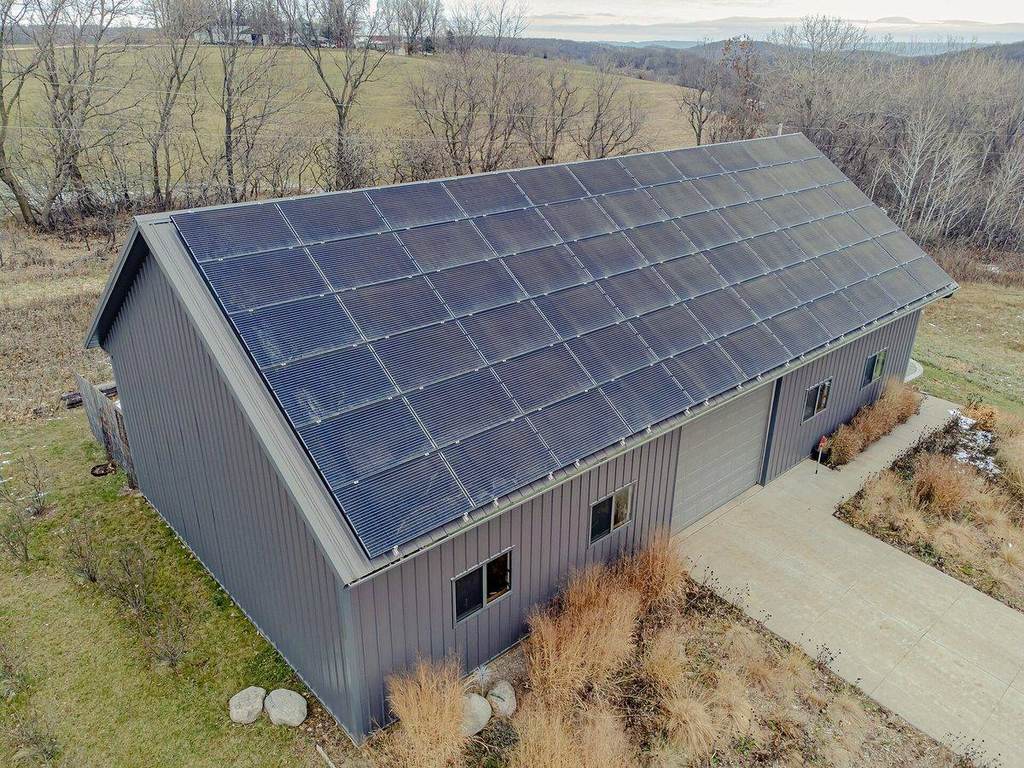
Yield depends mainly on your location. The national average is about 965 kWh per kWp per year, typically between 900 and 1,150 kWh (as of 2026). As a rule of thumb for quick sums, use about 1,000 kWh per kWp.
Yield rises 20 to 30 percent from north to south because solar radiation increases. The table shows specific yields by region, calculated with a uniform simulation at south orientation:
| Region | Yield per kWp | Yield of a 10 kWp system per year |
|---|---|---|
| Bavaria and Baden-Wuerttemberg (south) | 1,123 kWh | 11,230 kWh |
| Rhineland-Palatinate (west) | 1,100 kWh | 11,000 kWh |
| Berlin (east) | 1,055 kWh | 10,550 kWh |
| Lower Saxony (northwest) | 1,017 kWh | 10,170 kWh |
| Hamburg (north) | 985 kWh | 9,850 kWh |
| Schleswig-Holstein (north) | 983 kWh | 9,830 kWh |
(as of 2026)
In practice that means the same system in Munich delivers 20 to 30 percent more than in Kiel. Solar still pays off in the north, because even the roughly 983 kWh per kWp in Schleswig-Holstein sits comfortably above the profitability threshold (as of 2026).
Then there is the yearly distribution. About 73 percent of the yield falls between April and September: June is the strongest month at 14.5 percent and December the weakest at 1.6 percent (as of 2026). In winter the system only partly covers household demand, which is where storage and grid imports come in. For your specific location, orientation and tilt, the Photovoltaic yield calculator works through the detail.
Self-consumption: the biggest lever of all
This is the key to the return in 2026. Self-used solar replaces grid power at about 35 to 37 cents per kWh, while exported power earns only about 7.7 cents per kWh (as of 2026). A kilowatt-hour you use yourself is worth more than four times an exported one.
The self-consumption rate tells you how much of your own power actually reaches the house. It depends strongly on your usage:
| Scenario | Self-consumption rate |
|---|---|
| Without storage | 25 to 35 % |
| With battery storage | 60 to 70 % |
| With storage, electric car and heat pump | 80 % and more |
(as of 2026)
The difference is huge. For a typical 10 kWp system in southern Germany producing about 9,500 kWh a year, this is the annual benefit from electricity savings and feed-in tariff:
| Self-consumption rate | used yourself | exported | annual benefit |
|---|---|---|---|
| 30 % | 2,850 kWh | 6,650 kWh | around 1,560 € |
| 70 % | 6,650 kWh | 2,850 kWh | around 2,623 € |
(as of 2026)
Over 1,000 euros a year difference, from a higher self-consumption rate on the same system. The levers: plan a battery, shift use into sunny hours, charge the electric car during the day, use the surplus for a heat pump, and look into dynamic tariffs or energy management (as of 2026). How storage and self-consumption work out in your case is shown in detail in the Solar profitability calculator.
Battery storage: cost and value in 2026
Storage lifts the self-consumption rate massively, and prices in 2026 are lower than ever. A 5 to 10 kWh lithium battery (LiFePO4) costs about 440 euros per kWh including power electronics, and units over 15 kWh below 390 euros per kWh (June 2026). Compared with 2023, prices have fallen about 35 percent, when they were still above 700 euros per kWh (June 2026).
A few typical sizes for orientation:
| Storage size | Cost 2026 |
|---|---|
| Small unit (3 to 4 kWh) | 900 to 1,300 € |
| 10 kWh battery, hardware only | from about 3,000 € |
| Complete home storage incl. installation | 8,000 to 14,000 € |
(as of 2026)
Economically the battery often makes sense because it shifts the production cost of your own system, below 8 cents per kWh, into the evening hours where it would otherwise be lost (as of 2026). Around 95 percent of all new PV systems are now installed with storage (June 2026). Whether storage pays off for your usage and how big it should be is shown in the Battery storage calculator.
When the system pays back and what return it gives
A private rooftop system typically pays back after 7 to 10 years in 2026, depending on size, self-consumption and investment (as of 2026). Some sources say 5 to 9 years, others a more conservative 8 to 12, depending on the electricity price assumptions behind them (as of 2026).
An overview of payback periods (without allowing for rising power prices):
| System size | Investment (no storage) | Payback | Investment (with storage) | Payback |
|---|---|---|---|---|
| 5 kWp | 6,000 to 8,000 € | 8 to 10 years | 7,000 to 9,000 € | 7 to 9 years |
| 7 kWp | 8,000 to 9,500 € | 8 to 10 years | 10,000 to 12,000 € | 7 to 9 years |
| 10 kWp | 10,000 to 12,000 € | 8 to 9 years | 12,500 to 14,500 € | 7 to 9 years |
| 12 kWp | 12,000 to 14,000 € | 8 to 9 years | 15,000 to 16,000 € | 7 to 9 years |
(as of 2026)
After payback the system keeps earning for the rest of its 20-year tariff, and the modules technically often last 30 years and more. Rising power prices shorten the payback, because every kilowatt-hour you use yourself becomes more expensive (as of 2026).
The system return sits at 4 to 8 percent per year in 2026 (as of 2026), with conservative estimates at 3 to 6 percent (as of 2026). That beats many savings products such as day or fixed deposits, which often stay below 4 percent in 2026. For your personal number, the Solar profitability calculator works out payback and return for your own case.
Balcony solar: the fair way in without a roof
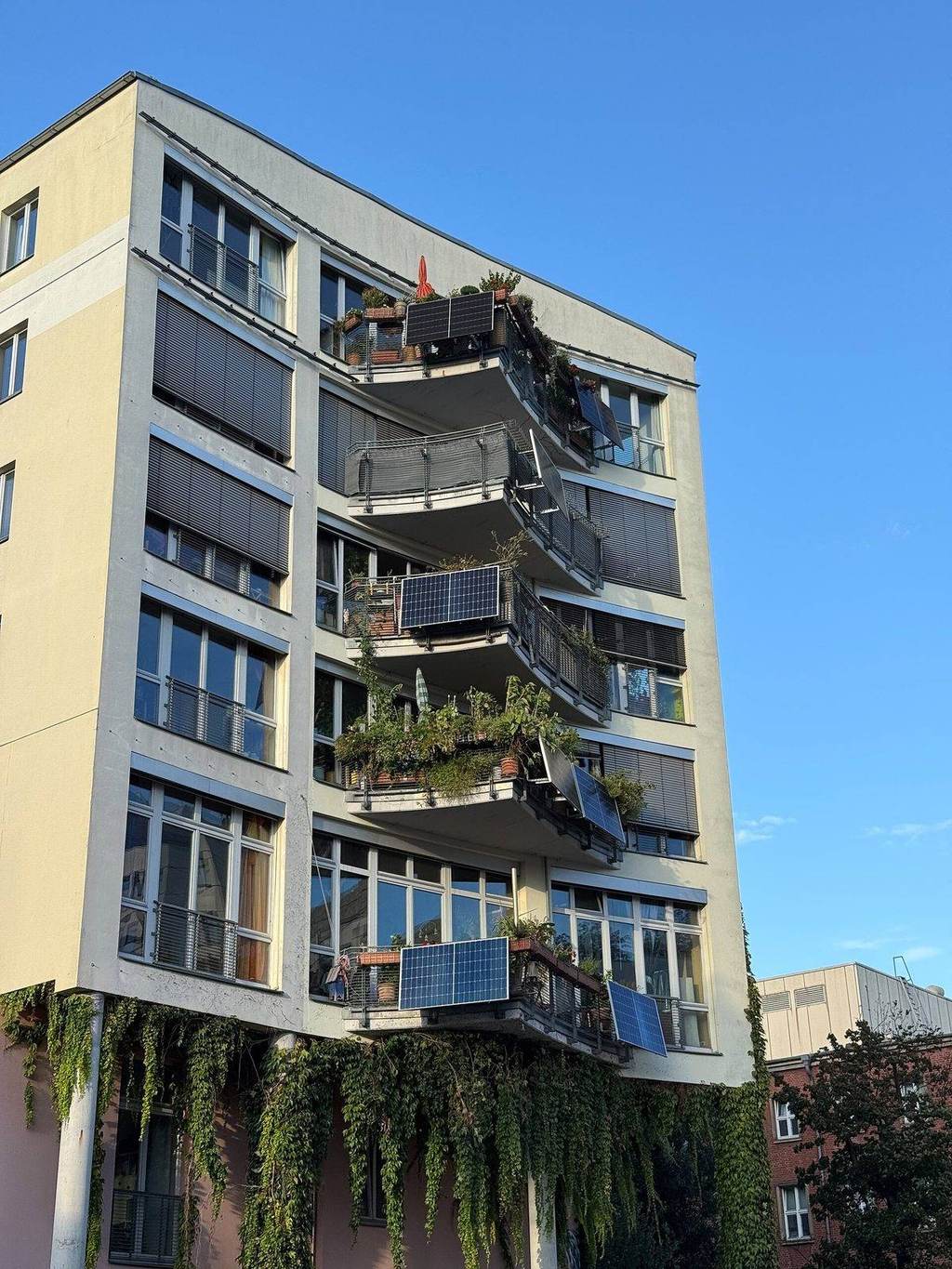
If you rent, have no suitable roof or want to test first, a balcony solar panel is a good starting point. The mini PV system consists of one to four modules and an inverter and feeds directly into your own house network through a plug socket.
The rules have become much friendlier since the 2024 Solar Package. The inverter output, what is actually fed in, is capped at 800 watts, while module output may reach 2,000 watts; more module capacity mostly adds yield at the edges of the day and with suboptimal orientation (as of 2026). The technical standard DIN VDE V 0126-95 has regulated since late 2025 which power may flow through which plug: a conforming complete device up to 960 watts of module output may run through a normal Schuko plug, above that it needs a special energy socket (as of 2026).
| Set type | Output | Price 2026 |
|---|---|---|
| Single set (1 module) | about 400 to 500 W | from 150 € |
| Standard set (2 modules) | about 800 to 1,000 W | 250 to 500 € |
| Complete set with storage | 800 to 1,000 W plus storage | from 700 € |
(as of 2026)
The yield of an 800-watt set in a good southern location is 600 to 900 kWh a year, in southern Germany sometimes over 900 kWh (as of 2026). Realistically 25 to 45 percent of it is used yourself without storage; an east-west set produces less but shifts the power into the morning and evening hours with the highest household demand, so it often saves more (as of 2026).
The saving is 90 to 150 euros a year. A set for 250 to 500 euros pays back after 3 to 5 years (as of 2026). For orientation, yield and savings in your specific case, the Balcony solar calculator gives the right numbers.
Balcony solar and renting: your rights
Since the rent reform in October 2024, tenants have a legal right under Section 554 of the German Civil Code to allow a plug-in solar device (as of 2026). The landlord may only refuse on valid structural or safety grounds, and a blanket ban is no longer allowed. Property owners have a right under Section 20 (2) No. 5 of the German Condominium Act. The landlord may still set reasonable requirements, such as a stable mounting, a data sheet for the complete system or a conforming device (as of 2026).
Subsidies in 2026: KfW, BAFA and the federal states
The subsidy landscape has shifted in 2026. One important tip first: look at your own region, because most of the money sits not at the federal level but in the state and municipality.
KfW. The classic is the Renewable Energies Standard loan (KfW 270), a low-interest loan covering up to 100 percent of eligible costs for PV systems, storage and wallbox, with terms up to 30 years (as of 2026). The earlier grant combination KfW 442 for solar plus electric car is now closed (as of 2026).
BAFA. There is no longer a direct federal grant scheme for new PV systems through BAFA. BAFA remains relevant for energy consulting and the individual refurbishment roadmap, in which PV measures can be funded as a supporting measure (as of 2026).
Federal states. This is where the action is in 2026. A selection of active programmes:
| State | Programme | Core content |
|---|---|---|
| Baden-Wuerttemberg | Wohnen mit Zukunft | low-interest loans for PV and storage |
| Berlin | SolarPLUS | grants up to 30,000 € for storage and PV on listed and facade buildings |
| Bremen | Photovoltaik nach Plan | loans up to 50,000 € for PV and storage |
| Hamburg | Solar and green roof funding | grants for substructure on green roofs |
| Saxony | Sachsenkredit Energie | loans for PV over 30 kWp, repayment bonuses |
(as of 2026)
Many municipalities such as Frankfurt, Stuttgart or Duesseldorf pay additional investment grants, some up to 10,000 euros, often tied to green roofs. For balcony solar panels, more and more cities offer 50 to 500 euros (as of 2026). An ordered overview of the right programmes for you is in the Solar funding overview.
Feed-in tariff 2026 and the outlook for 2027
The feed-in tariff is no longer the main driver of the return, but it secures an income for exported power. For systems commissioned between 1 August 2026 and 31 January 2027, these rates apply according to the Federal Network Agency:
| System size | Partial feed-in | Full feed-in |
|---|---|---|
| up to 10 kWp | 7.70 ct/kWh | 12.22 ct/kWh |
| 10 to 40 kWp | 6.66 ct/kWh | 10.24 ct/kWh |
| 40 to 100 kWp | 5.44 ct/kWh | 10.24 ct/kWh |
(Aug. 2026)
The tariff is fixed for 20 years at commissioning and no longer reduced afterwards (as of 2026). Since February 2024 the rate for new systems falls by 1 percent every six months, with the next cut on 1 February 2027 (as of 2026). What your system size currently earns is shown in the Feed-in tariff calculator.
There are two regulatory points worth knowing. First, since the Solar Peak Act in February 2025, new systems no longer receive a tariff in hours with negative wholesale prices (as of 2026). Second, the federal cabinet decided in July 2026 on a draft EEG reform under which the fixed tariff for new systems would end in January 2027, replaced by a lower transitional rate. Important: so far this is only a draft. Anyone installing in 2026 secures the current fixed tariff for the full 20 years (as of 2026).
Registration and law: do not skip this
The administrative part has shrunk, but it remains mandatory. Every grid-connected photovoltaic system and every balcony solar panel must be registered in the Federal Network Agency's market master data register (MaStR). This is free, done online and takes about 30 minutes (as of 2026). The deadline is one month after commissioning, set out in Section 71 EEG and Section 5 MaStRV.
Since the 2024 Solar Package, a single MaStR registration is enough for a balcony solar panel; a separate notification to the grid operator is no longer required in the standard case (as of 2026). Missing the registration can cost you the feed-in tariff and bring a fine of up to 50,000 euros (as of 2026).
One note on balcony solar compensation: in the standard case the surplus is delivered to the grid free of charge, and no tariff is provided. That is exactly why self-consumption matters almost exclusively for plug-in solar (as of 2026).
Saving tax with your own system
The tax reliefs since 2022 and 2023 are the quiet co-earner of every private system. Five points in summary:
Income tax free up to 30 kWp. Income from feed-in and the value of your own consumption has been tax exempt since 2022, retroactively under Section 3 No. 72 of the Income Tax Act (as of 2026). For typical private systems this removes income tax, trade tax and the obligation to determine profit. The system does not appear in the tax return and accordingly cannot be depreciated.
0 percent VAT. Since 1 January 2023, the zero rate under Section 12 (3) of the VAT Act applies to the supply and installation of PV systems up to 30 kWp, storage and wallboxes (as of 2026). That makes the purchase noticeably cheaper.
No business needed. Because of the tax exemption, private systems up to 30 kWp need no business registration. What counts is neither how much you feed in but the system size and its allocation to private assets (as of 2026).
When it changes. Larger systems over 30 kWp and roofs in the commercial sphere fall under the normal rules. Then income from a trade, profit determination and depreciation over the official useful life of 20 years apply, equal to 5 percent per year (as of 2026).
For the great majority of private operators, systems up to 30 kWp, the tax-friendly rules remain. Because the rules depend on size and asset thresholds, it pays to cross-check your own situation against Section 3 No. 72 of the Income Tax Act and Section 12 (3) of the VAT Act before investing.
What pays off most in 2026: the order of play
If you are weighing whether solar is worth it, you can think through the decision in four steps, deliberately from small to large:
- Balcony solar as a start. For renters and everyone without a roof: 250 to 500 euros invested, payback in 3 to 5 years, legally secured rights. A good, low-risk first step.
- Optimise self-consumption. Whatever system, consumption decides. Put use into sunny hours, and where relevant run the storage numbers.
- Rooftop system with self-consumption. The lowest prices ever and a return of 4 to 8 percent secured over the 20-year tariff.
- Full scenario. System plus storage plus electric car or heat pump lifts the self-consumption rate above 80 percent and raises the return further.
Wherever you start, the calculators on this page help you run the numbers for your own case instead of the average: the Photovoltaic yield calculator for site yield, the Solar profitability calculator for payback and return, the Battery storage calculator for the storage question, the Balcony solar calculator for the start, the Feed-in tariff calculator for the tariff and the Solar funding overview for the right grants.
Frequently asked questions
Is a solar system still worth it in 2026?
How much does a PV system cost per kWp in 2026?
How long does a PV system take to pay back?
How much power does a 10 kWp system produce per year in Germany?
What is the 2026 feed-in tariff and when does it drop?
How high is the self-consumption rate and how do I raise it?
Is a battery storage system financially worth it in 2026?
How much does a balcony solar panel cost in 2026 and when does it pay off?
Do I have to register a solar system?
Do I have to pay tax on solar power?
This handbook is general guidance and does not replace legal, tax or financial advice. Electricity prices, feed-in tariffs and subsidies change, and many figures vary by region. Check specific offers, legal points and deadlines for your own case, and have a specialist installer support the registration.
Sources & status of these figures
The figures in this handbook come from the sources listed and were last checked on 16 September 2026. Market values, electricity prices and legislation change, so each current figure carries a date. Anecdotal values are marked as such in the text.
- Federal Statistical Office (Destatis): 4.8 million PV systems by end of 2025, press release 12.03.2026. destatis.de
- Strom-Report: Photovoltaics Germany, charts and additions, January 2026. strom-report.com
- Energie-Experten: Battery storage prices 2026, 30.06.2026. energie-experten.org
- EnergieFluss24: PV yield in Germany, kWh per kWp by region, 2026. energiefluss24.de
- ADAC: Photovoltaic subsidy and feed-in tariff 2026, Federal Network Agency table. adac.de
- ADAC: Registering a balcony solar panel and rules, 2026. adac.de
- Enpal: Current feed-in tariff 2026 and EEG reform 2027, 03.08.2026. enpal.de
- Verbraucherzentrale: Market master data register, duties and deadlines. verbraucherzentrale.de
- Gruenes.Haus: Depreciation and tax exemption of PV systems 2026. gruenes.haus
- reduco.ai: Feed-in tariff 2026/2027, EEG reform and balcony solar yield. reduco.ai
- Finanztip: Registering a balcony solar panel and costs. finanztip.de
- enerix: Solar system costs and feed-in tariff, 2026. enerix.de
- LeoSpardo: PV self-consumption optimisation and examples, 2026. leospardo.de
- gesetze-im-internet.de: Sections 3 No. 72 and 12(3) Income Tax Act, Sections 49 and 51 EEG, Section 5 MaStRV